

2 to 6 players, about 20 minutes
Earthquake
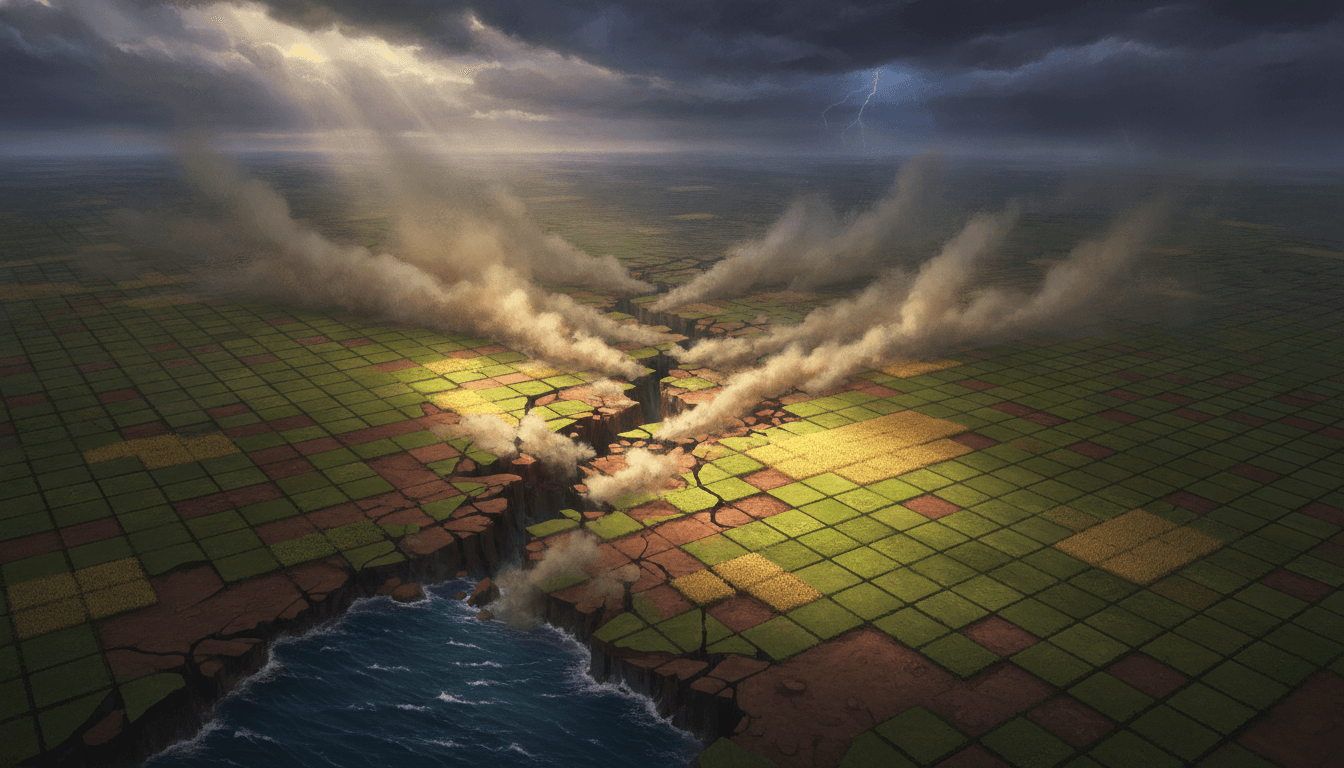
A drafting game with a sliding puzzle bolted on the end. Pick tiles from a line everyone can see and build a 4x4 board of fields, clay, ocean and wheat. Then the earthquake hits: 5 minutes to slide tiles into the empty slot and grow your two best terrains into the biggest areas you can.
The pieces
Four terrains, ninety tiles, one pawn
Tiles
Every tile is a 2x2 patch of land. Most show all four terrains. The ones everyone wants carry a pair of the same terrain, side by side or on the diagonal. No tile has three of a kind.
All four / side pair / diagonal pair
Terrains
Fields, clay, ocean and wheat. Each appears on exactly 90 cells across the set, so no terrain is rarer than another. What's rare is the pair you need, at the moment you need it.
- Fields
- Clay
- Ocean
- Wheat
Board, line and pawn
Each player has a 4x4 board of 16 slots. The tiles for the game (15 per player) lie face up in a line read like text. The pawn sits in the line and marks where the next player chooses from.

The three tiles after the pawn are the choice.
How a game goes
Four phases: pick, shake, register, score
 1
Pick
Build your land one tile at a time.
Tip. The tile you skip is the tile the next player gets. Picking is also blocking.
- Score 17
Clay 10 + Ocean 7
2Shake
Five minutes. Only you see your board.
Tip. Plan the slides backwards from the board you want, then walk the empty slot there.
- 3:12Register (5 left)1Ben
 212Amy183You17
Your board right now: 17. Not registered yet.
3Register
Lock in a score when you like what you see.
Tip. Register early, then improve. A registration you don't need costs you nothing.
- Clay 154
Score
Your two best terrains, added together.
Tip. Two strong terrains beat one huge one. The third and fourth only matter in a tie.
Scoring, on a real board
Count the areas, add the best two
Score: 13 + 11 = 24. The other two terrains (6) only matter in a tie. Hover a row to see that area on the board.
Strategy
What the good players do
Pairs are gold
Tiles with two cells of the same terrain are the ones to fight over. A pair carries an area from one tile into the next; a single cell has to get lucky.
Keep the pair off the edge
A pair against the board edge can only grow inward. Put early pairs in the middle, where they can connect on every side.
Choose a main and a second
Pick a main terrain early and a second one soon after. Going for all four spreads you thin; one terrain alone caps your score.
Watch the line
The three tiles after the pawn are everyone's business. If the player after you wants the green pair, taking it costs you nothing.
Leave yourself slides
During the pick, think about the shake. A board where every tile is boxed in can't improve; keep the empty slot near the work.
Count twice
The scoreboard shows your rivals' best. If you lead by three, protect it; if you trail by one, hunt for a single cell.
At the table
Undo, absences and leaving
Taking a pick back
Right after your pick, before anyone else picks, you can ask to undo it. Everyone else has to agree. One no, or the next pick, ends the request.
Someone goes quiet
If the player on turn hasn't moved for 3 minutes, the others see it and can vote to remove them. The vote has to be unanimous among the rest, and their next pick cancels it.
Leaving
You can withdraw at any time from the menu. During the pick, your turns are skipped and the draft ends when everyone left has 15 tiles. During the shake, your best score stands.
The host
The host starts the game once every seat is filled, can cancel it at any time, and starts the rematch from the results screen.
Questions
Quick answers
- How many players?
- 2 to 6. The game uses 15 tiles per player, so a 2-player game draws from 30 tiles and a 6-player game from all 90.
- How long does it take?
- About 20 minutes: the pick takes most of it, the shake is exactly 5 minutes.
- Can I rotate during the shake?
- No. Rotation is free when you place a tile; after that a tile only slides.
- Can I see other boards during the shake?
- No. Only your own, plus everyone's best registered score on the scoreboard.
- What if I never register?
- Your board from the start of the shake was registered for you, so that's your score.
- Do diagonal cells connect?
- No. Only cells that share an edge connect, including across tile borders.
- What if the line runs low?
- When fewer than three tiles are left, you pick from what's there.
- Does the browser remember me?
- Yes. Sign in once with the emailed code and you stay signed in for a year.
Ready?
Create a table, send the code, and start when everyone's in.